Early U.S. Navy Afterburner Development Efforts
Part 3e: McDonnell Aircraft Corporation – Continued Development and Flight Test
by Paul J. Christiansen
Published 2 Jul 2026
| Part 1: Ryan Aeronautical | Part 2a: Solar Aircraft: Early Design and Development |
| Part 2b: Solar Aircraft: Production Design and Development | Part 2c: Solar Aircraft: Production Testing and Continued Development |
| Part 2d: Solar Aircraft: Production Testing and Continued Development | Part 2e: Solar Aircraft: Final Testing and Program End |
| Part 3a: McDonnell Aircraft: Initial Proposal and Development | Part 3b: McDonnell Aircraft: Continued Development |
| Part 3c: McDonnell Aircraft: Continued Development | Part 3d: McDonnell Aircraft: Continued Development and Flight Test |
| Part 3e: McDonnell Aircraft: Continued Development and Flight Test | Part 3f: McDonnell Aircraft: Final Tests and Project End |
| Part 4a: Westinghouse Aviation Gas Turbine Division Background and the Initial Effort – The J34-WE-11 |
Part 4b: Westinghouse Aviation Gas Turbine Division (in process) |
McDonnell Aircraft, St. Louis, Missouri
23 October 1949: Muroc Weekly Summary Progress Report of XF‑88 & XF‑88A Report No. 1357.
Further background on the intent of JA‑34‑MD‑15 AB tests in the XF‑88A was given. The primary objective was to determine the best fuel‑air ratio for maximum thrust augmentation at all altitudes. The original fuel control was to have a fixed nozzle area for wet operation and allow a by‑pass motor valve, regulated by the TOT, to maintain balanced‑cycle operation throughout the range of altitudes. This approach had proved to be unsatisfactory by itself since the motor by‑pass valve had sufficient capacity only for regulation over a range of 3,000 – 4,000 ft of altitude for one fixed nozzle area.
As a result, it was deemed necessary to have, for test purposes, a method for the pilot to vary the nozzle area. Three fuel‑air ratios were tested by means of flow adjustment on the AB fuel control valve and flights to various airspeeds and altitudes. During the flights, the nozzle area was pilot‑adjusted to maintain balance‑cycle operation. This was the TOT limit at 12,500 rpm with the AB wet. To maintain the constant fuel‑air ratio the motor valve was disconnected from the system. The result was that all control of the fuel flow for balance‑cycle was through the nozzle area adjustment.
Of the three ratios tested, 0.044 proved the best ratio, providing the best augmentation. This was determined by the attainment of the highest maximum airplane speed, both ABs wet and using a fuel‑air ratio versus nozzle area plot for balanced‑cycle operation. This determination method was chosen over the use of compressor differential versus AB fuel flow since a change in nozzle area reflected any change in the compressor differential and consequent fuel flow. The plot had also shown that there was no indication of a peak efficiency having been obtained with the fuel‑air ratios tested with this JA‑34‑MD‑15 burner. Such a peak would have manifested itself in a drop‑off nozzle area required for an increase in the fuel‑air ratio. Speed variation had had little effect on the nozzle area required. While insufficient fuel‑air ratios were obtained to definitely establish a curve, the general trend of the variation was indicated.
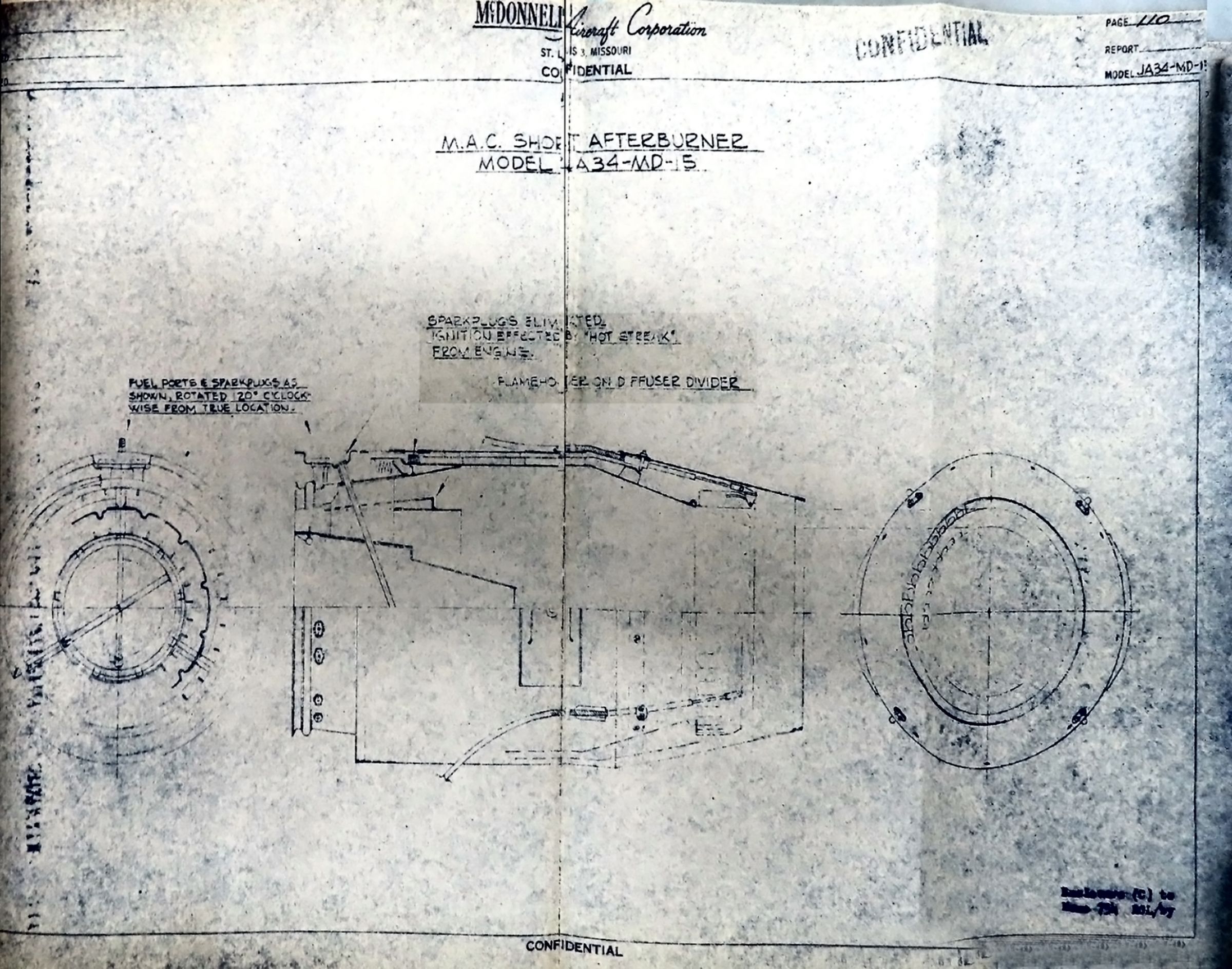
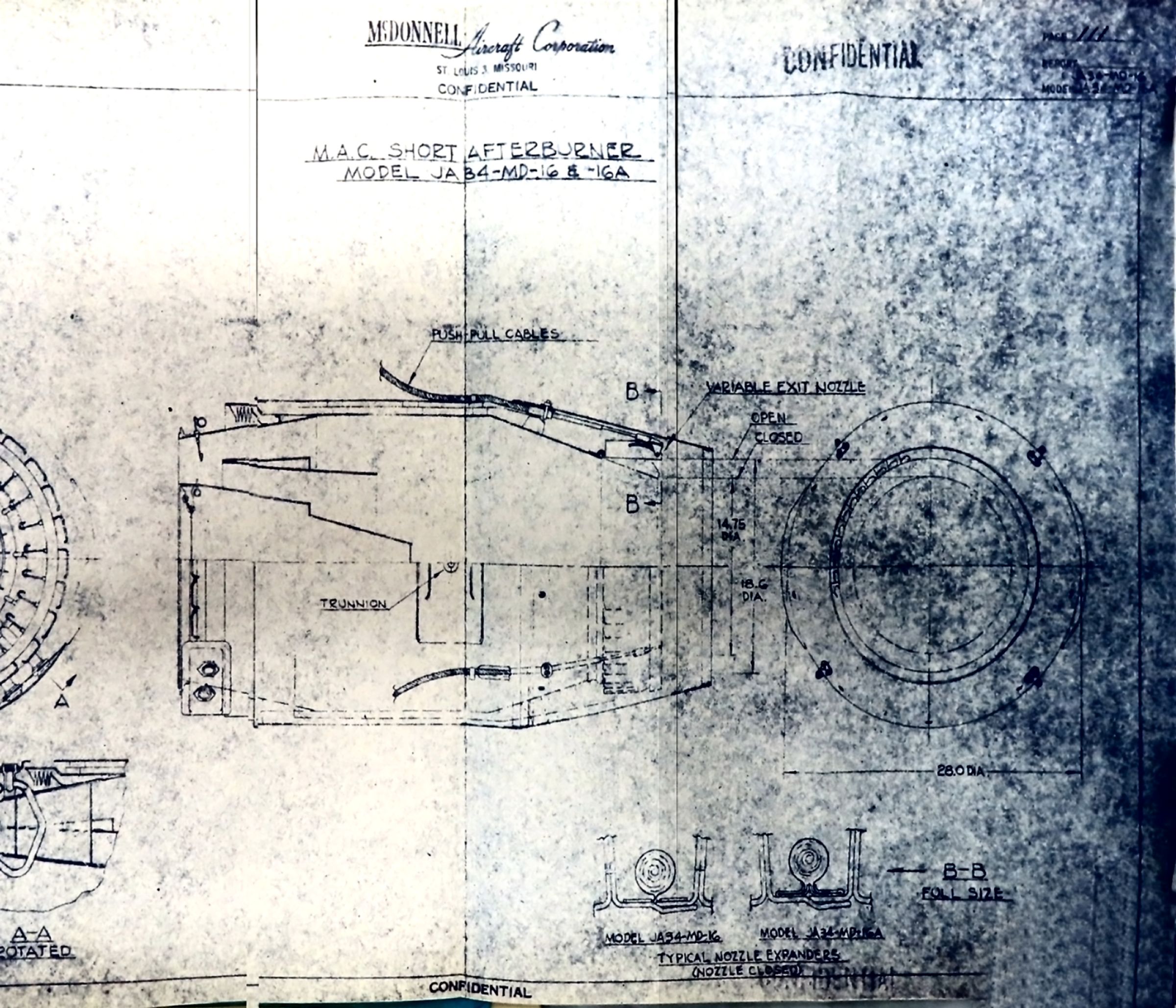
Testing of the JA‑34‑MD‑15 model indicated that the best efficiency could not be obtained by having the outer fuel injection nozzles spraying directly toward the burner center as the changing flow patterns through the burner were directing fuel away from the flame holders. To improve things, the outer burner ring fuel injection nozzles were changed so that fuel was now injected away from the burner center by lengthening each nozzle and bending it 180°. The outer flame holder slope was also changed slightly. The new burner was designated the JA‑34‑MD‑16.
Since the new burners would obtain maximum efficiency at a lower fuel‑air ratio than the JA‑34‑MD‑15 model, a new testing technique was required and would be applied. The AB fuel by‑pass motor valve would be made operative, regulated by limiting the TOT. At a selected altitude, the pilot would select a series of nozzle areas allowing the motor valve to regulate the fuel flow for red line temperature and the consequent fuel‑air ratio. The tests would be repeated for two or three altitudes. The fuel‑air ratio data collected from the curves for each altitude would allow the fuel supply curve slope to be set.
| AB Operating Times Summary for the Entire Test Series, 1 September to 12 October | |
|---|---|
| Total Flights with Afterburning | 26 |
| Total Single AB Take‑offs | 25 |
| Total Dual AB Take‑offs | 1 |
| Total AB Flight Time | 3.28 hr |
| Total AB Time Including Ground Operation | 4.65 hr |
The JA‑34‑MD‑16 ABs were installed and the engines (WE020017 and WE020103) were calibrated with the new ABs. WE020103 with AB No. 4 was installed as the L/H engine. WE020017 while No. 5 was installed as the R/H engine. Additional fiberglass insulation was installed under the stainless steel heat shield to provide more thermal protection during AB operation. Ground runs were made with the fuel flow schedule set with the pressure‑operated valve to give a fuel‑air ratio from 0.035 to 0.040.
30 October 1949: Muroc Weekly Summary Progress Report of XF‑88 & XF‑88A Report No. 1436.
Low altitude testing began with the fuel flow set to provide a fuel‑air ratio considered very nearly optimum for low altitudes and high speed operation as had been determined from test cell data. Two flights were dedicated to check the nozzle positioning apparatus functioning and the development of hot spots. Initially it was found impossible to obtain red line TOT on the L/H AB due to intermittent nozzle control. Two observed dark spots behind the flame holder struts were eliminated by pinching the outer ring fuel nozzles adjacent to the struts. Considerable difficulty was encountered in flights 41 and 42 in nozzle area adjustment and during flight 41 full open nozzle area could not be attained; adjustments were made by rerouting the tele‑flex cables to eliminate binding. This was only partially effective and problems were experienced on the next flight on the L/H AB. Data was obtained at 0.8 Mach with both ABs wet at 10,000 feet. A dual AB run was made at 10,000 ft during flight 43. During the take‑off of flight 43 with both ABs wet, the pilot had difficulty in keeping the TOT within 20°C of the red lines. Due to differences indicated in the cockpit between the L/H and R/H AB areas, it was suspected that the R/H area shown on the cockpit indicator was not accurate. The instrumentation was to be inspected.
| AB Operating Times Summary for the Entire Test Series, 1 September to 12 October | |
|---|---|
| 46‑526 | |
| Total Flights During which ABs were Used | 29 |
| Total Take‑offs with One AB Operating | 25 |
| Total Take‑offs with Both ABs Operating | 2 |
| Total AB Flight Time | 3.58 hr |
|
|
| JA-34-MD-15 Afterburner | JA-34-MD-16 Afterburner |
Additional data on the design difference between the ‑15 and ‑16 models was given. The combustor section had been redesigned to eliminate the faired‑over wall step flame holder of the ‑15 and now incorporated instead an optimum divider step flame holder diffuser in the design. Also, the radially inward injection of fuel from the outer burner ring was changed to provide radially outward fuel injection by use of hook type nozzles. It was expected the new combustor design would give longer nozzle life due to cooler outer strata of gases. The fuel injection nozzle change was expected to result in improved performance and ignition characteristics.
5 November 1949: The Bureau of Aeronautics Resident Representative (BARR) reported that McD had requested an increase in the rejection to overhaul limit for AB operating time; as then established in Engine Bulletin No. 37; from two (2) to three (3) hours. The change would be consistent with the recent increase in all condition time and Military time from 50 to 150 and 5 to 10 hours respectively. Experience had shown that in no case was a deficiency found in an engine after two hours of AB time that would not have been found by inspecting the engine after every two hours of Military time. If the extension was granted for total AB time, sufficient time was available on the current engines to complete the current AB test program on the F2H‑1. If not granted, three additional engines would be required. The current spare engine WE022017 had only 25 minutes of allowable AB time remaining.
7 November 1949: Muroc Weekly Summary Progress Report of XF‑88 & XF‑88A Report No. 1438. On flight 526‑45 the AB fuel by‑pass valves were made operative and the program to determine the optimum fuel‑gas ratios begun. This first flight in the program went to 15,000 ft with plans to vary the nozzle area and allow the motor valve to adjust the fuel flow to balanced cycle. Unfortunately, no data were obtained due to the inability to properly adjust the L/H nozzle area and the improper ignition and burning on the R/H engine.
Post flight ground runs showed that proper burning could not be maintained using the recommended 0.75:1 fuel ratio between the inner/outer rings when used in the current AB configuration. Also, it was discovered that the L/H nozzle actuation control relays were intermittent, preventing proper nozzle adjustment. Actions taken were to change the fuel manifold ratio to 1:1 and the replacing the relay box. The flight plan was to be repeated on flight 526‑46 but this flight suffered an overheat warning on the L/H engine. The flight was aborted and a single engine cross wind landing was attempted. On touch down, the left‑hand main gear leg failed and a minor crash occurred. The pilot was uninjured. The airframe was to be returned by truck from Muroc to McD’s company facilities in St. Louis for repair.
9 November 1949: McDonnell Accident Report, Model F2H‑1 Airplane, BuNo 122530, Report 1448. Flight 530‑187, on 26 October 1949, was terminated early after the pilot experienced symptoms of anoxia at 25,000 ft. The mission had been to make an early evaluation of the F2H‑1 airplane with McD JA‑34‑MD‑15 ABs installed. During the landing, the pilot flared too high. Rapid throttle advancement to the Normal position did nothing to reduce the sharp and rapid decent that had developed. The initial impact was on the main gears and a large bounce resulted. The second impact was primarily on the right main gear and after rolling to a stop the right tire was found to be flat. Several minutes later the left main gear tire was found to also be flat. Minor other damage was found but was too small to be photographed.
14 November 1949: The Navy Bureau of Aeronautics (BuAer) authorized the AB time limit on the three specific engines being used in the AB program to be raised from two to three hours. A Class B inspection was required on an engine after it accumulated two hours of AB operation. The BARR was to advise BuAer of the serial numbers on the engines affected.
16 November 1949: A request from McD for specified quantities five different type flight test instruments for the AB testing program was forwarded by BuAer to its Flight Test Division at Patuxent River. This informed McD that the instruments were to be returned to Pax River at the conclusion of the tests.
18 November 1949: Contract NOa(s)‑9768, Model F2H‑2 Airplanes – Proposal for Afterburner Installations, Report 892A‑31A.
McD responded to a request from BuAer for a price and a delivery proposal for the installation of McD short ABs in four (4) F2H‑2 airplanes. Discussion included McD’s observation that the development of automatic controls for ABs had not kept pace with AB development and a major effort was needed to advance controls development in order to have automatic controls available for service test. The current process of controlling the temperatures using electric switches was adequate for experimental test flight operation but was not considered safe for service test purposes.
The projected price for development and ground tests, F2H modifications, flight tests, liaison and service qualification tests was $624,100.00. Since the Navy wished there to be no increase in the contract NOa(s)‑9022, McD suggested a postponement of price redetermination of that contract and consideration be made to issuing a “no price increase amendment” to Contract NOa(s)‑9768. The proposal superseded all prior proposals and was based on the acceptance and concurrent performance of the work covered in McD’s letter (actually not received until 22 December 1949, and not found).
Deliverables would be two variable‑nozzle ABs of McD design essentially similar to those installed in F2H‑1 BuNo 122530, two spare ABs and two spare sets of AB controls packed for domestic shipment FOB McD’s plant. Delivery of all items would be four (4) months after receipt of authorization to proceed.
23 November 1949: McDonnell Aircraft Corporation, Accident Report, XF‑88A Airplane 46‑526, Flight 526‑45, Contract W33‑038‑sc‑14582. The L/H engine was cut off immediately after take‑off due to an overheat warning light. Even after cutoff, the warning light remained lit and was blinking. When the gear was lowered for a single engine landing, the L/H landing gear did not indicate down and locked and was recycled, the second try obtaining a down and locked condition indication. Altitude and speed were lost during the landing gear cycling. The aircraft was beginning to settle so the landing gear retraction was started for a go around attempt. Altitude was being lost so rapidly that the landing gear lever was moved to the down position again and the base turn discontinued. A cross‑wind landing on the lake was attempted. The airplane stalled 30 ft above the ground, flaps up, gross weight approximately 19,300 lb and a cross wind of 17.5 kts.
The main gear and tail skid contacted the ground. The left main gear collapsed and cleared the airplane after punching a hole in the underside of the left wing. The airplane then skidded 5,000 ft on the left wing tip, rolling on the right gear and nose wheel. Damage was confined to the left main gear, left wing, right wing gear attachment, L/H engine exhaust shroud, and the tail section. Inspection of the overheat detector system revealed that one bulb had been struck when installing the L/H afterburner, shorting the bulb internally. The light was still on when power was applied when inspected; moving the bulb slightly caused the light to go out.
28 November 1949: Installation and Evaluation of Afterburner in F2H‑1 Airplane under Contract NOa(s)‑9022, Progress Report for Period 16 August through 15 October 1949. The ABs installed in the F2H‑1 were JA34‑MD‑15 models. During the period, the primary flight test objective was F2H‑1 operational and performance characteristic investigation and improvement. The first flight test series was made to determine the optimum fuel flow and nozzle area for good AB performance over a range of altitudes and at airspeeds conducive to high rates of climb. Additionally, the initial flights were to familiarize the pilot with the AB installation and its controls as well as to adjust the engine governor for variable nozzle and AB operation.
Subsequently, short periods of AB wet operation in level flight were made at several altitudes up to 35,000 ft with approximately a 0.035 fuel/air ratio. Ignition was good up to 25,000 ft but above that altitude some partial ignition was obtained. Satisfactory ignition up to 35,000 ft could be obtained with proper piloting technique. The AB operation was quite sensitive above 25,000 ft to nozzle area variations and changes in transient conditions. One flight was made with both ABs wet from take‑off in a climb to 40,000 feet. Both ABs operated satisfactorily up to 31,000 ft. At that altitude the R/H AB blew out due to a sudden change in nozzle area. The L/H AB was turned off at 38,000 feet. A second climb was attempted to 40,000 ft with both ABs wet. The L/H AB was satisfactory up to 40,000 ft but the R/H AB blew out at 34,000 feet. The cause of this blowout had not yet been determined, but was thought to be related to a combination of rapidly changing, transient conditions and the necessity for close manual control of the nozzle area. The limitations of the current semi‑automatic control were obvious and an investigation was initiated with the objective of a control system able to provide complete fully automatic AB control. The next test period would focus on investigation and improvement of operation at higher altitudes. As of 15 October 1949, the L/H AB had accumulated 24.7 hr of engine time, 1.46 hr of which were AB wet. The R/H AB had 20.16 and 0.54 hr respectively.
Other static ground testing had continued at Westinghouse in Lester, Pennsylvania during the period. The AB model was designated the JA34‑MD‑16. Test results with a modified injection system had revealed that a variation in the fuel injection orifice position with respect to the flameholder had a large effect on performance. An optimum fuel injection orifice location was determined from tests. This modification gave a considerable improvement in AB ignitability, combustion stability and combustion efficiency. The fuel required for ignition was only 50% of that required for maximum (engine) thrust at static sea level conditions. The reduced fuel flow for ignition, improved performance over a range of fuel gas ratios and the higher combustion efficiency of the new model were expected to substantially improve the high altitude performance.
High temperature oxide gradients on the JA34‑MD‑15 AB nozzle had shown that the nozzle temperature was not uniform around the periphery during low fuel flow and high altitude AB operation. The cooler spot was in a position opposite the fuel manifold inlet and indicated the ‑15 had partial fuel vaporization within the manifolds. This could result in excessive heating of the AB fuel. It was possible that this factor contributed to combustion instability at high altitude. In the ‑16 model; heat transfer from the diffuser wall to the outer manifold was eliminated by supporting the manifold away from the wall and wrapping with asbestos insulation. The inner manifold was already mounted away from the wall in previous designs and was also wrapped with asbestos insulation. The new official designation for the improved model was the “M. A. C. Short Afterburner, Model JA34‑MD‑16”.
5 January 1950: Weekly Summary Flight Report Week Ending 1 January 1950, Report 1511.
Data was collected related to an investigation into the possible thrust increase at altitude if variable area nozzles were installed on Westinghouse J34 engines. (Just the engine nozzle, not AB related). The TOT was measured at altitudes up to 40,000 ft and at Mach numbers from 0.6 to 0.8 in order to determine the range of flight conditions under which it was possible to obtain TOT red‑line temperature using the present fixed area nozzles. The results were not yet available to report.
A climb to 40,000 ft was made with the entry speed raised from 0.70 Mach to 0.75 Mach. This was to determine if the improved airspeed would afford sufficient improvement in AB thrust to provide an increase in excess power and consequently in rate of climb. Since the new procedure also eliminated the previously used zoom at the end of the climb, the resulting data could not be directly compared to the previous climb data results. Also, the airplane gross weight was significantly different. It was going to be necessary to await completion of the reduction of all test data to standard conditions and to a common gross weight.
Operationally, the AB and engine operation was smooth throughout the climb. The sensitivity of the AB nozzle controls had been increased and this had apparently produced the desired effect as no appreciable TOT hunting had been evident. The TOT on the R/H engine had been stabilized but was 30°C below redline. Above 24,000 ft, the temperature on the L/H engine fell off slowly until at 40,000 ft it was approximately 100°C below redline. This indicated the minimum nozzle area was slightly greater than desirable for the flight condition. The rpm on both engines was steady and no excessive speeds were encountered.
13 January 1950: Justification for a Contract Amendment Negotiation. This amendment was to be put in place to implement McD’s suggestion to put their ABs on an F2H‑2 and do limited testing. If approved, it would be Amendment 19 to Contract NOa(s) 9768.
a. “Install in one F2H‑2 airplane a (crossed out and “two” written in) M.A.C. short afterburners (JA34‑MD‑16) with a fully automatic control system and conduct approximately 4 hours flight testing, in accordance with enclosure (1) and enclosure (A) thereto.
b. “Supply two (2) spare afterburners and two (2) spare sets of afterburner controls packed for domestic shipment f.o.b. contractor’s plant.” The $175,925.00 price was crossed out and “No Increase in Contract Price” written instead. The justification given was: “To provide an F2H‑2 airplane equipped with a MAC short afterburner with a fully automatic control system for flight evaluation of the afterburner, and for early investigation of the interceptor problems with an actual flight article.”
19 January 1950: Interim Summary Progress Report on Afterburner Tests, Report 1507. The report covered F2H‑1 flight tests when equipped with JA34‑MD (model not specified) up to 31 December 1949. It also included comparative analysis of the AB equipped airplane with a standard F2H‑1 not so equipped. At sea level, a 19,600 feet per minute rate of climb of was obtained as compared to 9,600 feet per minute obtained from a standard F2H‑1. At 40,000 ft, the rate of climb was 3,500 feet per minute compared to 1,800 feet per minute. The time to climb from sea level to 40,000 ft, corrected for standard conditions, was 4.4 minutes compared to the standard F2H‑1’s 8.6 minutes. The best of the actual climbs was accomplished by starting at a climbing speed at 2,000 feet and reaching 40,000 ft in 3.7 minutes. High speed with ABs was 23 kts higher than the standard F2H‑1 with J34‑WE‑22 engines and 15 kts higher than the airplane with the J34‑WE‑34 engines. The climbs were made with an interim automatic control that operated successfully up to the point where abnormal engine behavior occurred. This was suspected to be the cause of the compressor stalling experienced on AB shutdowns. The AB had been ignited and operated for a short time at 44,000 ft and operated throughout a Mach number range from 0.4 to 0.83 at 40,000 ft. This indicated that the combustion characteristics of the AB were satisfactory at altitudes in excess of the engine and governor operating limits. The fact that the measured performance was seen to be substantially equal to that calculated indicated the AB had a thrust augmentation almost up to that anticipated. Further improvements outlined in Enclosure (A) (not found) were fully expected to result in sufficient thrust augmentation to equal or exceed the performance estimated and also result in an AB of substantially increased service life. In view of the favorable results determined to date, McD requested that additional engines be assigned to carry on this flight test program. A written note attached says a final firm estimate of seven (7) engines was needed and a memorandum request was in progress. The Maintenance Division was requested to coordinate the diversion of the additional engines should the request be accepted. An undated second note says the memo was received and the seven engines had been provided. A third note dated 28 February 1950 says the Maintenance Division could not support a “carte blanche” approach to supporting the project. When a final firm estimate of the requirements was forthcoming in a memorandum from the Piloted Aircraft Division, a decision could be made as to the Maintenance Division’s ability to support the tests. A further concurrence with the latter note stated that the Maintenance Division could not provide blanket support for experimental programs. When the Power Plant Division and Aircraft Division determined the number of engines required for the program, the Maintenance Division could evaluate engine availability. (It is not possible to determine if the 7 engines were made available, but in March McD said they could complete their tests with the current engines on hand.)
12 February 1950: Weekly Summary Progress Report of XF‑88 & XF‑88A Report No. 1568. After flight 526‑97 of the first XF‑88 serial 46‑525, the airframe was put in protracted work status for installation of McD short ABs and wing root fuel cells.
22 March 1950: BuAer asked McD to extend the tests work on the F2H‑1 being used for the AB testing to include installing variable nozzles of the engines and report the test results in the weekly summary reports. This was to be done at no increase in the contract price.
31 March 1950: McD reported the variable nozzle tests could be completed with the remainder of the Military time (4 hr) on the two engines then assigned to the AB tests, serials WE022096 and WE022121.
2 April 1950: Weekly Summary Progress Report of XF‑88 & XF‑88A Report No. 1636. Prior to flight, in addition to airframe strengthening and additional fuel tank storage installation in the wing roots (in lieu of the fire extinguisher system in that space), the AB fuel system had automatic hot streak ignition and constant proportioner for inner and outer fuel rings added. All damage from the crash was repaired and McD JA34‑MD‑16B ABs were installed. The AB controls were modified to provide an emergency system that caused the nozzle to go full open during AB operation or full closed during non‑afterburner operation. Limited inverted flight capability was added by modifying the oil tanks with swivel pickups. On the XF‑88A, functional checks were performed and found to be generally satisfactory during climbs to 2,000 ft and level flight at 10,800 ft. A slight fluctuation in the TOT during a single AB climb from 15,000 to 30,000 ft was noted. The hot streak ignition was also checked and found to be satisfactory. Flights 526‑47 to 526‑52 were performed bringing the total flight time on the airframe to 36.09 hours.
| Total Flights where ABs Were Used | 38 |
| Take‑offs with One AB Operating | 27 |
| Take‑offs with Both ABs Operating | 11 |
| Total AB Time | 4.1 hrs |
It was thought a change in sensitivity on the amplifier controlling the variable nozzle would correct the TOT fluctuation issue.
9 April 1950: Weekly Summary Progress Report of XF‑88 & XF‑88A Report No. 1637. Further checks on the AB were performed on flights 526‑53 and 526‑54. These included two AB take‑offs, a climb from 15,000 to 30,000 ft (R/H AB wet only), automatic hot streak starts at 30,000 ft and a check of the manual nozzle control at high indicated airspeeds. All checks were generally satisfactory. Total airframe time after the two flights was now 38.34 hrs.
| Total Flights Where ABs were Used | 40 |
| Take‑offs with One AB Operating | 27 |
| Take‑offs with Both ABs Operating | 13 |
| Total AB Time | 4.4 hrs |
For the climb, the R/H AB was ignited at 0.5 Mach at 15,000 ft and the airframe accelerated to 0.75 Mach at which speed a climb was made to 30,000 ft. Automatic hot streak starts were made at 0.75, 0.80 and 0.85 Mach at 30,000 ft. Only partial light‑off was obtained at 0.75 Mach, but both the 0.80 and 0.85 Mach light‑offs were fully successful. The manual control on the nozzle was checked to be sure the variable nozzle actuators were powerful enough to close the nozzles at high exhaust velocities. The nozzles were opened and closed manually and the TOT returned to within 10°C of its former setting. This indicated the nozzle actuators were satisfactory at high air speeds. No quantitative data was collected during these functional checks.
A. The original estimate of 7 J34‑WE‑34 engines was based upon 2 engines for McD test stand use and probable NACA testing, plus 5 engines for flight tests. The latter number established by “ratioing” engines required to flight hours for present and proposed programs. No provisions were made for testing at Westinghouse since the assumption was made that all Westinghouse testing would be conducted with their test house engines as was previously done. (Note: Interestingly, the author had found no such mention of such in house engine usage in any BuAer or Westinghouse correspondence during his research for his book on J34 development.)
B. A second estimate of the total number of engines required was based on past engine failure experiences as follows:a. Engine times logged on each engine.
b. Since the times logged on the satisfactory engines generally exceeded the average of those logged on rejected engines, the estimate should not include the two remaining engines in the airplane. Those two engines would be used to conduct the authorized variable nozzle program.
Engine Serial No. All Conditions Military Power Afterburning WE022017 67.8 10.9 2.3 WE022044 16.4 3.1 0.5 WE022049 51.7 7.4 1.3 WE022117 24.2 3.3 0.5 WE022018* 10.1 0.4 None Engine Times for Engines Currently Installed WE022096 51.0 5.5 1.3 WE022121 43.4 4.9 1.5 *Not used in AB program as a 10 hr inspection had revealed a foreign object had passed through the engine cutting up the turbine area.
c. Experience with the AB program showed that only approximately one half of the engine time would be accumulated during flight. Assuming 35 hours of flight time for an extended AB program, four engines plus one engine for contingencies or five engines total would be required.
d. An additional two engines would still be required for McD test stand and NACA testing.
| Total Flights where ABs were Used | 46 |
| Take‑offs with One AB Operating | 27 |
| Take‑offs with Both ABs Operating | 19 |
| Total AB Time | 4.67 hrs |
23 April 1950: Weekly Summary Progress Report of XF‑88A Report No. 1639. Investigation of the R/H burner over‑temps during the ferry operation revealed that the turbine temperature control amplifier was inoperative. With no replacements available, the fuel flow was adjusted to allow using the burner as a fixed nozzle burner for take‑offs only. This proved to be satisfactory over two flights, 526‑61 and 526‑62. Both flights were used for aerial gunnery tests to USAF Specification 34014‑A.
Total airframe time after the six flights was now 46.01 hrs.
| Total Flights where ABs were Used | 48 |
| Take‑offs with One AB Operating | 27 |
| Take‑offs With Both ABs Operating | 21 |
| Total AB Time | 4.79 hrs |
30 April 1950: Weekly Summary Progress Report of XF‑88A Report No. 1640. Two flights were made for rocket firing and bomb dropping testing. The ABs were used on both take‑offs. On flight 526‑63, the R/H AB was slow in response to temperature control. Both ABs were ignited satisfactorily at 0.65 Mach at 16,000 ft, but again the R/H AB was slow in temperature response. Its temperature control amplifier was adjusted after the flight. On flight 526‑64, both ABs were satisfactory during take‑off. At 15,000 ft, both were ignited at 0.60 Mach number and the TOTs were controlled satisfactorily. At 25,000 ft and 0.60 Mach both ABs were again ignited but “apparently” only partial burning was obtained, as the TOT dropped below the red line to approximately 550°C. Accelerating the airplane to 0.65 Mach, the temperatures suddenly increased to the red line and were then controlled.
| Total Flights where ABbs were Used | 50 |
| Take‑offs with One AB Operating | 27s |
| Take‑offs with Both ABs Operating | 23 |
| Total AB Time | 4.86 hrs |
1 May 1950: Contract NOa(s)‑9022, Model F2H‑1 Airplane – Summary Progress Report on Afterburner Tests, Submittal of (forwarded to BuAer by the BARR 31 May 1950). Flight tests had been done to establish the cruising fuel consumption with ABs installed. When compared with the calculated range data for the standard airplane, the data had shown that there were “no large losses in range due to the AB installation.” It was deemed consistent with ground tests that had shown thrust losses of only 1 – 2% and that for low thrust actual savings in SFC over the standard area fixed nozzle were possible. To obtain comparative ignition data at various airspeeds and altitudes, an automatic ignition system was installed, which required only that an electrical circuit be energized to obtain AB ignition and in conjunction with the automatic nozzle area control already incorporated maintained the temperature‑controlled AB operation after ignition. The AB had been successfully ignited up to 40,000 ft. The unit had been manually ignited up to 44,000 ft and had been operated up to 48,000 ft. A total of 7.5 hr of AB time had been accumulated during the tests to date with approximately 5.9 of these hours being in flight. It was felt the satisfactory results would meet the requirements. Additional improvement areas had been suggested by the testing. Following the improvement work, the AB and control system would be ready for type testing. (Note: The attached copy of MAC Report No. 1608, “Afterburner Summary Progress Report, Model F2H‑1” was not found.)
a. Modify a government-owned Model F2H‑1 Airplane Bureau No. 122530 (including installation of a variable nozzle afterburner of McDonnell Aircraft Corporation design, and conducting of ground and flight tests thereon) in accordance with BuAer TWX 171341Z, dated 17 May 1949.
b. Conduct further development and tests on the variable nozzle afterburner in accordance with MAC Report #5‑239 revised 29 November 1949 “Model Specification, McDonnell JA34‑MD Afterburner and Automatic Control System.”
c. Submit bi‑monthly engineering progress reports and engineering data, sketches, reports, etc. resulting from Items (a) and (b).
The work under Items (a), (b), and (c) shall be completed within 10 months after receipt of this amendment by the contractor. “The total estimated cost of (a) and (b) was $421,705.00. Of the $205,199.00 estimated cost for part (a), $189,779.00 represents actual costs from inception of the program through 4 December 1949.”
7 May 1950: Weekly Summary Progress Report of XF‑88A Report No. 1641. Both the XF‑88 and XF‑88A were now flying with JA34‑MD‑16B afterburners installed. All take‑offs used the ABs on both aircraft. One complaint was on the automatic regulation of the R/H TOT of the XF‑88A. The ignition characteristics of the ABs were checked at 30,000 ft at 0.65, 0.75 and 0.85 Mach with the best ignition obtained at 0.65 Mach.
Flight 525‑45 on airplane 46‑525 was a shakedown flight and no data were obtained. Five flights (526‑65 to 526‑69) were made with the XF‑88A 46‑526. Various tests of guns, bombing and combat suitability were made.
| 46‑525 | 46‑526 | |
|---|---|---|
| Total Flights During which ABs were Used | 1 | 54 |
| Total Take‑offs with One AB Operating | 0 | 27 |
| Total Take‑offs with Both ABs Operating | 1 | 28 |
| Total AB Flight Time | 0.10 hr | 5.14 hr |
14 May 1950: Weekly Summary Progress Report of XF‑88 & XF‑88A Report No. 1642. XF‑88A was placed on work status to prepare it for additional Phase II evaluation tests (not related to the ABs). The XF‑88 made a flight, 525‑99, primarily testing AB ignition with the inclusion of other operational tests at various altitudes. Operation above 27,000 ft was unsatisfactory due to the inability of the governor to hold 12,500 rpm on the L/H engine, and because of improper turbine temperature regulation above 31,000 ft on the R/H AB.
| 46‑525 | 46‑526 | |
|---|---|---|
| Total Flights During which ABs Were Used | 2 | 54 |
| Total Take‑offs with One AB Operating | 0 | 27 |
| Total Take‑offs with Both ABs Operating | 2 | 28 |
| Total AB Flight Time | 0.31 hr | 5.14 hr |
21 May 1950: Weekly Summary Progress Report of XF‑88 & XF‑88A Report No. 1643. The XF‑88A made three take‑offs with the ABs operating satisfactorily. The L/H AB was not satisfactory above 25,000 ft, requiring a high Mach number for ignition at 30,000 ft and no ignition at any higher altitude. The R/H AB ignition could be accomplished up to 36,000 ft although a high Mach number was required. In climbs, wet operation could be sustained on the R/H engine up to 40,000 ft with proper TOT control. The L/H AB was unsatisfactory in climb above 36,000 ft, the TOT dropping off rapidly above that altitude. Also, the L/H engine fuel control could not maintain maximum rpm. Compressor stalls accompanied shut‑downs at high altitudes.
The XF‑88 made climbs to 32,000 ft at 0.80 and 0.83 Mach number. Ignition attempts at 35,000 ft were unsatisfactory due to the minimum AB (nozzle area) being critical, resulting in compressor stalls when too small and no ignition when too large. A third climb was abandoned because of improper TOT control.
| 46‑525 | 46‑526 | |
|---|---|---|
| Total Flights During which ABs Were Used | 6 | 57 |
| Total Take‑offs with One AB Operating | 0 | 27 |
| Total Take‑offs with Both ABs Operating | 6 | 31 |
| Total AB Flight Time | 0.69 hr | 5.94 hr |
28 May 1950: Weekly Summary Progress Report of XF‑88 & XF‑88A Report No. 1644. The primary purpose of the flights on the XF‑88A were a general shake‑down of the airplane and afterburners prior to turning the airplane over to Air Force Material Command (A.M.C.) for tests. The ABs were turned on at various altitudes and at different Mach numbers to determine the light‑off characteristics and adjustments made as necessary. No ignition could be made of the L/H AB at any altitude and after the flight, the hot streak AB ignition spark plug was completely clogged. After flight 526‑74, the airplane was determined ready for the A.M.C. tests.
The XF‑88 was ferried from St. Louis to Edwards AFB on 22 May 1950 to be utilized in Phase II testing if necessary. The pilot noted the AB fuel flow was too low. This was adjusted and a checkout flight accomplished. Afterwards, it was determined the AB fuel flow proportioners’ piping to the fuel rings were reversed, explaining the poor performance on the prior flights.
| 46‑525 | 46‑526 | |
|---|---|---|
| Total Flights During which ABs Were Used | 11 | 60 |
| Total Take‑offs with One AB Operating | 0 | 27 |
| Total Take‑offs with Both ABs Operating | 11 | 33 |
| Total AB Flight Time | 1.07 hr | 6.71 hr |
4 June 1950: Weekly Summary Progress Report of XF‑88 & XF‑88A Report No. 1645. Phase II flight testing continued on the XF‑88A. On flight 526‑78, the AB TOT temperature was not properly regulated as it was making excessive fluctuations. Normally, it was held within ±5°C of the red line. The sensitivity adjustment did not completely remedy the fluctuations especially at altitudes between 25,000 and 35,000 ft. The experimental R‑46 governors also did not maintain the rpm at those higher altitudes and the maximum speed of the engines could not be maintained. The inadequate fuel supply from the governors required adjustment, but this did not improve the supply materially. Engine rpm continued to drop at altitude. Flight 526‑80 gave an indication that the instability of the governors and the TOT control were somehow linked. A check flight of the XF‑88, with production R‑46 governors installed, determined that the engines were properly regulating the AB TOT and rpm. Kits were sent from the Holley Corporation to modify the XF‑88A engines’ experimental governors to the current production standard.
The new temperature control amplifiers were found to be unable to be adjusted even on ground runs. These were removed and the old amplifiers were re‑installed. Three flights were needed to adjust these since ground running adjustments were not accurate above 30,000 ft.
| 46‑525 | 46‑526 | |
|---|---|---|
| Total Flights During Which ABs Were Used | 12 | 71 |
| Total Take‑offs With One AB Operating | 0 | 27 |
| Total Take‑offs With Both ABs Operating | 12 | 44 |
| Total AB Flight Time | 1.23 hr | 10.83 hr |
11 June 1950: Weekly Summary Progress Report of XF‑88 & XF‑88A Report No. 1646. The last flight (526‑85) of the XF‑88A reported on previously had found that the fluctuation of TOT of +/‑30°C was still occurring on the L/H AB. Adjustments to the amplifier were made and flight 525‑86 flown. The R/H AB was now satisfactory. The L/H AB would not ignite at 25,000 or 30,000 ft. Both engines were replaced for different reasons (excess oil consumption and excessive turbine blade clearance) and the L/H engine was fitted with a manual AB nozzle area control. Flight 526‑87 was wholly satisfactory. The XF‑88 was not flown.
| 46‑525 | 46‑526 | |
|---|---|---|
| Total Flights During which ABs Were Used | 12 | 78 |
| Total Take‑offs with One AB Operating | 0 | 27 |
| Total Take‑offs with Both ABs Operating | 12 | 51 |
| Total AB Flight Time | 1.23 hr | 13.21 hr |
14 June 1950: Contract NOa(s) 9768, F2H‑2 and ‑2N Airplane, Approval Request for AB Flight Test Airplane Choice. A wire to BuAer by the BARR passed on McD’s urgent request for approval of their choice of an F2H‑2N airplane (BuNo 123308) for the AB testing. It was chosen because the extra weight of the electronic equipment in the nose would help offset the weight and balance impact of the AB addition. The BARR objected, reasoning it was not desirable to utilize a night fighter when a day fighter airframe was available. Also, more conclusive test data would be obtained using a standard day airframe inasmuch as it was possible that necessary ballasting in the AB configuration would adversely affect performance characteristics.
16 June 1950: XF‑88A Accident Report 1722. Flight 526‑105 on 16 June 1950 ended in a gear up, flaps down crash landing on the lakebed. The front (No. 1) bearing on the R/H engine had failed causing the second stage of the compressor rotor to fail, ejecting blades through the compressor casing, some of which struck the L/H compressor casing. A fire started first in the R/H engine compartment and spread to the L/H engine compartment. Both engines were shut off prior to the landing and the fire went out. The ABs had not been used for take‑off or at any other point in the flight. Post landing inspection showed that significant airframe damage had occurred from the engine failure, fire and the landing itself.
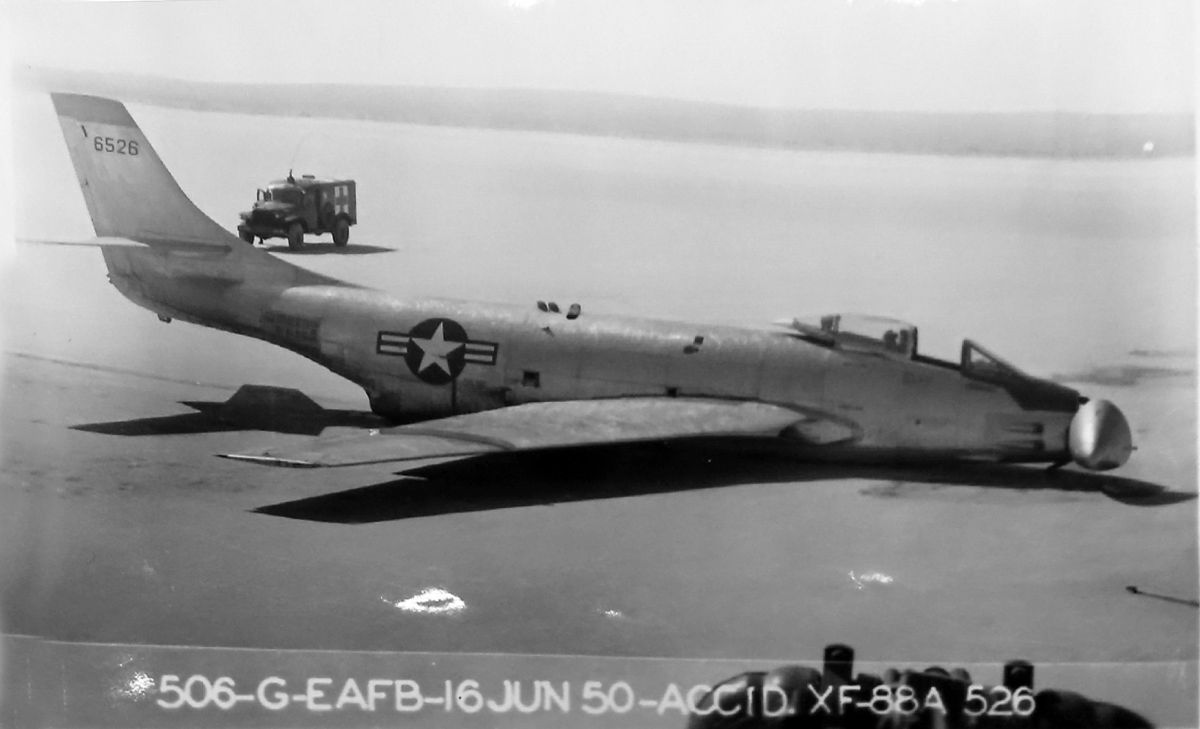 |
| Fig. 3. XF‑88A No. 46‑526 on the Lakebed after the Forced Landing |
18 June 1950: Weekly Summary Progress Report of XF‑88 & XF‑88A Report No. 1721. Because of the damage to the XF‑88A, the XF‑88 was being reworked to prepare it for use in the scheduled tactical evaluation. Prior to flight 526‑102, the manual nozzle control was removed from the cockpit. The post‑crash inspection of the airframe was not yet complete. No flights were made with the XF‑88.
| 46‑525 | 46‑526 | |
|---|---|---|
| Total Flights During which ABs Were Used | 12 | 91 |
| Total Take‑offs with One AB Operating | 0 | 27 |
| Total Take‑offs with Both ABs Operating | 12 | 53 |
| Total AB Flight Time | 1.23 hr | 16.93 hr |
25 June 1950: Weekly Summary Progress Report of XF‑88 & XF‑88A Report No. 1723. On the XF‑88, AB No 13 was installed on the R/H engine and No. 12 or the L/H. Three check‑out and familiarization flights were made. The AB performance was satisfactory. (This report includes the full post‑crash damage evaluation report on 46‑526 following its wheels up landing on the lakebed.)
2 July 1950: Weekly Summary Progress Report of XF‑88 & XF‑88A Report No. 1724. The XF‑88 engines were changed to the J34‑WE‑34 model and the installation plumbing and accessories were modified slightly. The L/H AB operated satisfactorily, but the R/H had to be adjusted after flight to correct a ‑40°C below red line control issue. The L/H governor would not hold 100% rpm above 30,000 ft and this was also adjusted. Nine tactical evaluation flights were made after the contractor post engine change check flight. No AB issues were encountered during the evaluation flights.
| 46‑525 | 46‑526 | |
|---|---|---|
| Total Flights During which ABs Were Used | 27 | 91 |
| Total Take‑offs with One AB Operating | 0 | 27 |
| Total Take‑offs with Both ABs Operating | 23 | 53 |
| Total AB Flight Time | 1.23 hr | 16.93 hr |
9 July 1950: Weekly Summary Progress Report of XF‑88 & XF‑88A Report No. 1726.
| 46‑525 | 46‑526 | |
|---|---|---|
| Total Flights During which ABs Were Used | 42 | 91 |
| Total Take‑offs with One AB Operating | 0 | 27 |
| Total Take‑offs with Both ABs Operating | 38 | 53 |
| Total AB Flight Time | 9.77 hr | 16.93 hr |
The XF‑88 tactical evaluation flights continued. After flight 525‑117 the Barber‑Coleman (manufacturer of temperature controls) control boxes on the ABs were replaced. After 525‑118, the fuel flow to the R/H AB was increased. After 525‑135, both hot streak plugs were replaced.
16 July 1950: Weekly Summary Progress Report of XF‑88 & XF‑88A Report No. 1727. On the XF‑88, three familiarization flights by Air Force pilots, one contractor demonstration flight and one check flight were made. The latter was made after the replacement of both ABs due to cracking of three nozzle segment expanders. The new ABs performed satisfactorily.
| 46‑525 | 46‑526 | |
|---|---|---|
| Total Flights During which ABs Were Used | 47 | 91 |
| Total Take‑offs with One AB Operating | 0 | 27 |
| Total Take‑offs with Both ABs Operating | 43 | 53 |
| Total AB Flight Time | 9.77 hr | 16.93 hr |
23 July 1950: Weekly Summary Progress Report of XF‑88 & XF‑88A Report No. 1728. >On the XF‑88, 3 pilot familiarization flights were made. The ABs were mostly satisfactory. One attempt to light the L/H burner at 35,000 ft and 0.83 Mach was unsuccessful. No compressor stalls on AB shutdowns were encountered with the new engines.
| 46‑525 | 46‑526 | |
|---|---|---|
| Total Flights During which ABs Were Used | 50 | 91 |
| Total Take‑offs with One AB Operating | 0 | 27 |
| Total Take‑offs with Both ABs Operating | 46 | 53 |
| Total AB Flight Time | 9.77 hr* | 16.93 hr |
| *Not updated in report for the 3 flights. | ||
30 July 1950: Weekly Summary Progress Report of XF‑88 & XF‑88A Report No. 1729. One contractor flight of the XF‑88 was made. The plane was then prepared to be shipped to St. Louis, all Air Force test flying having been completed. The XF‑88A would be shipped by truck to St. Louis as well. All reporting from Edwards was now complete.
| 46‑525 | 46‑526 | |
|---|---|---|
| Total Flights During which ABs Were Used | 56 | 91 |
| Total Take‑offs with One AB Operating | 0 | 27 |
| Total Take‑offs with Both ABs Operating | 52 | 53 |
| Total AB Flight Time | 14.63 hr* | 16.93 hr |
| *Includes the 3 flights reported previously. | ||
[End Part 3e of the Early US Navy Afterburner Development Efforts – McDonnell Aircraft Corporation]
Send mail to
 with questions or comments about this web site.